


As software platforms scale to serve multiple clients with distinct requirements, customizations often saturate backend and frontend layers, producing tightly coupled systems and increasing maintenance costs.
This article presents a configuration-driven approach to managing per-client feature variability in full stack applications, treating configuration as an explicit architectural layer that is interpreted consistently across the system to decouple client-specific behavior from core business logic and presentation code, while enabling behavioral changes without synchronized deployments or feature branching.
The approach is evaluated through a practical implementation, illustrating how disciplined configuration management supports scalable personalization while preserving architectural integrity.
SaaS platforms gradually undergo architectural drift as tenant variability is introduced without an explicit variability model. Usually systems that are unified codebases in the beginning tend to have variations over time as enterprise clients ask for customized workflows, data processing rules, or different interfaces. Development teams resort to tenant-specific behavior in the application layer to fulfill these requests. Typical approaches include encoding tenant-specific behavior via conditional logic on tenant identifiers, isolated client modules, or long-lived feature branches, effectively embedding product decisions directly into application code. Even though these methods may help meet short-term delivery deadlines, they ultimately make the system structurally more complex.
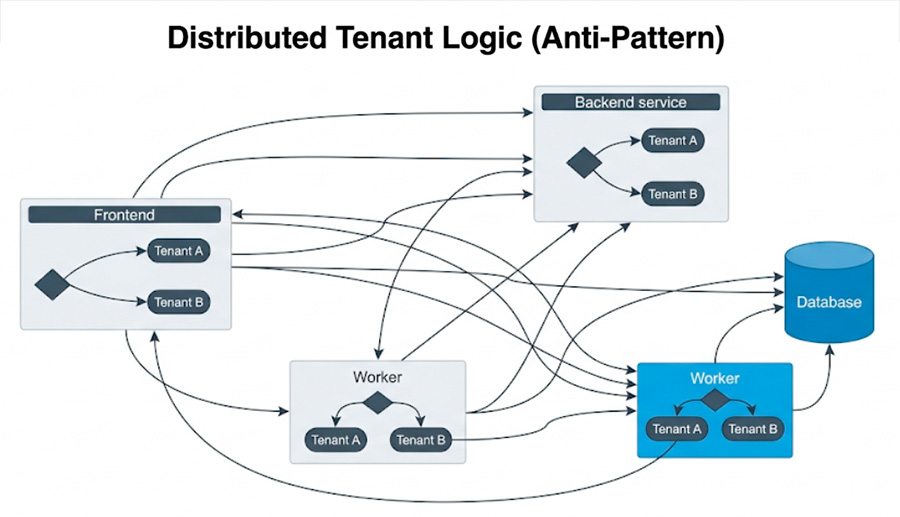
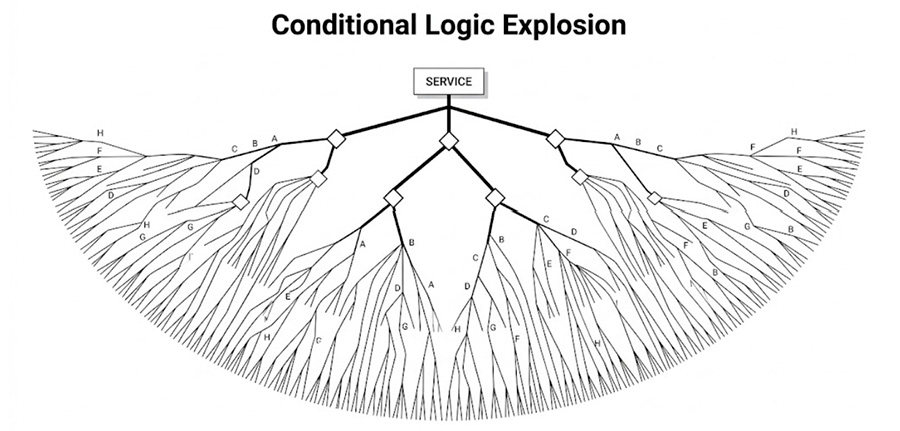
The presence of this tenant-driven logic probably does not come from lack of good engineering practice but rather from a deeper architectural problem of encoding client variability as executable application logic instead of expressing it as a structured, schema-governed configuration model. Since the number of tenants will be increasing, the number of capability combinations will grow just as fast, creating a combinatorial explosion in the system state space, exceeding practical limits for reasoning and testing.
And now, capability interactions are not only hard to understand but also expensive to test. Eventually this leads to what can be called configuration entropy: the uncontrolled proliferation of configuration states without an explicit resolution model or constraint system governing their interactions.
When the configuration sources are scattered among environment variables, database records, and application code, one has to reconstruct runtime conditions manually to understand the behavior of a particular tenant. For fully multi-tenant SaaS platforms, this variability issue turns into an architectural matter instead of just a straightforward implementation problem.
One of the most difficult and persistent architectural problems in multi-tenant SaaS platforms is the uncontrolled propagation of tenant-specific behavior across multiple architectural layers.
In practice, when the requirements of the clients are implemented directly in the application logic, the codebase accumulates tenant-specific execution paths whose only purpose is to satisfy individual tenants. This can be called behavioral leakage: tenant-specific rules escaping their intended configuration boundaries and entering core domain services. As this happens, the platform's domain model starts to show the historical accumulation of client exceptions instead of a business capability set.
The main reason for this situation is the lack of an explicit model separating platform capabilities, tenant entitlements, and governing policies. Instead of deciding what the system can do and which tenants are allowed to access those capabilities, the changes are implemented by adding some tenant-based conditional logic.
Furthermore, a few technical signs often appear as a result of this architectural pattern:
Conditional Branching Proliferation
Core services gradually accumulate tenant-specific conditionals such as:
With increasing customization demands, these conditionals spread across multiple system layers such as application services, controllers, background workers, and even persistence logic.
Schema Divergence and Data Model Fragmentation
Tenant modification quite often results in the spreading of the data model. Extra tables, tenant-specific columns, or different schema variants are created to accommodate workflow differences or reporting needs. At this point the schema starts to identify tenant distinctions instead of domain concepts, thereby making it more and more difficult to maintain a single platform model.
Deployment Coupling
Enabling new capabilities becomes part of the release process. If specific tenant behaviors are coded inside the application, turning on a feature for just one client might even involve the whole service being rebuilt and redeployed. This violates blast radius isolation, as tenant-scoped changes propagate as system-wide operational events.
Testing State Explosion
If tenant differences are expressed in code via if-else chains rather than through a structured, schema-governed configuration model, the state space of the system increases dramatically. The capability interaction space grows so fast that testing all cases is no longer feasible and feature interaction bugs become more probable.
Operational Debugging Complexity
Production debugging becomes significantly more complex when tenant behavior is figured out not from a single configuration source, but from the combination of code conditionals, environment variables, config tables, and runtime flags.
To figure out what a tenant's behavior really is, one might have to manually investigate different layers of the system. The platform starts to be reorganized around tenant exceptions instead of platform capabilities. This results in new client requirements typically leading to additional conditional branches (if-else chains) rather than a thorough architectural model. In mature multi-tenant platforms, tenant identity should be a factor to determine entitlements but not the behavior of the domain itself.
The deterioration of multi-tenant architectures is rarely caused by a single engineering error. Usually, it is mainly the consequence of a minute set of structural design decisions that simply seem harmless when a platform is at its early stage; however, they become a source of problems when the tenant base expands.
Generally, these breakdowns carry a hallmark: the system's behavioral variability is largely encoded directly in the application rather than regulated through formally structured configuration models. Therefore, as demand for tenant-specific customization increases, the platform misses the architectural possibilities to depict product variability in a disciplined manner.
Typically, one or more of the following factors cause such shifts:
Absence of a Capability Model
Most SaaS platforms do not explicitly characterize the capabilities offered by their system. Rather than outlining the functional perimeter of the platform and regulating which tenants have access to each capability, the behavior is changed through patch increments introduced for different clients.
In the absence of an explicit capability model, a system has no stable abstract concept to represent product variability. New features are added as tenant-specific exceptions instead of extending a well-defined set of capabilities. Gradually, the domain model starts reflecting historical client contracts more than the platform's real functionality.
Mature multi-tenant architectures typically differentiate between the following concepts:
• Capabilities → what the platform can do
• Entitlements → which tenants may use those capabilities
• Policies → rules governing capability behavior
• Overrides → controlled tenant-specific deviations
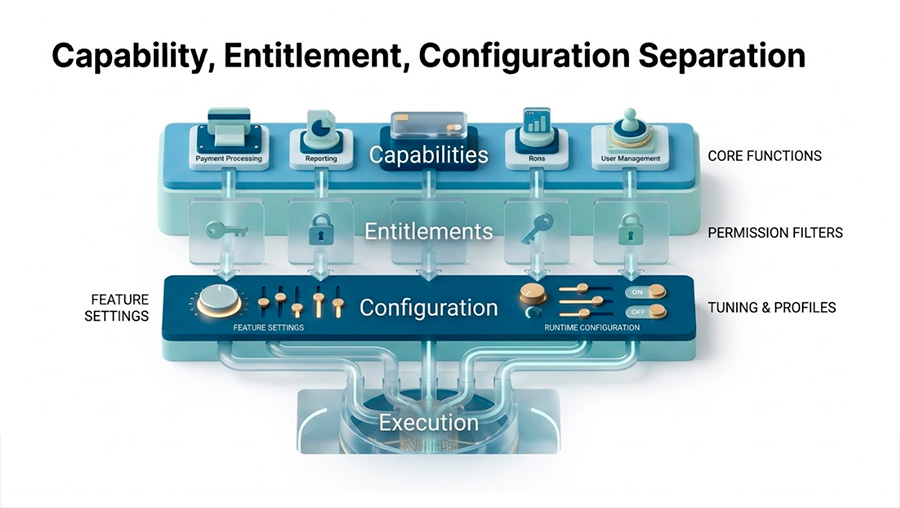
Without this structure, tenant customization becomes indistinguishable from core domain logic.
Unstructured Configuration Systems
Configuration on many platforms is often implemented as loosely structured key-value data spread very casually across environment variables, database tables, and defaults in the application. This approach is acceptable for infrastructure-level settings, but it is not the right tool for the job when it comes to configuration representing product behavior.
Flat configuration models lack essential structural properties necessary for reliable multi-tenant operation:
Therefore, issues with the configuration will in many cases be detected only at runtime. A wrongly spelled key or a value missing could greatly change the behavior of the system without anyone noticing it at compile time.
Most of all, configuration is often treated as raw data instead of a first-class, schema-governed system model. For example, development, staging, and production environments diverge over time, and these differences lead to a configuration drift that is very hard to undo or reproduce the tenant behavior outside production.
Fragmented Capability Enforcement
A common failure mode occurs when system components independently interpret tenant configuration. For example, frontend apps, backend services, background workers, and reporting pipelines might each have separate logic on how they determine the availability of a capability.
As a result, the platform loses the ability to keep a single, true, and definitive source for the enforcement of capabilities. While one service might think a feature is enabled, on the other hand, another could interpret the same capability as disabled, thereby leading to behavioral inconsistencies across system boundaries. Such a problem is often noticed in distributed or event-driven architectures.
In these scenarios, several services that respond to the change in tenant state end up applying different interpretations to the same configuration. What happens is policy drift, with various parts of the software enforcing divergent interpretations of the capability model.
Deployment-Coupled Configuration
Tenant customization is very often directly linked to the application binary. When client-specific features are hardcoded into the software, changing a tenant's options means a complete rebuild and redeployment of the service.
This introduces tight coupling between two otherwise independent lifecycles:
Linking these lifecycles results in operational complications. Product teams have no way of changing tenant capabilities without involving engineering deployments, and even minor configuration changes carry the same operational risk as a full system release. Gradually, this dependency hampers not only the product iteration but also the operational stability.
In the industry, various methods are utilized to deal with behavioral differences among tenants. Such methods are good at fulfilling particular operational requirements.
However, if one relies on them solely for enabling long-term changes of tenants, they will, most probably, not be sufficient. Almost all these techniques have one thing in common: they primarily control binary activation of functionality without modeling behavioral variability. However, they hardly offer a formal pattern of how platform capabilities vary across tenants.
Feature Flag Systems (Runtime Decision Systems)
Feature management systems like LaunchDarkly and Unleash are now the most common tools for controlling feature availability. These platforms are even great for technical tasks such as gradual rollouts, A/B testing, and quick rollback of the newly released functionalities. Yet, feature flag systems are designed to control release behavior and short-lived runtime decisions and not to represent the long-term structure of product capabilities.
When tenant customization is primarily based on feature flags, these flags gradually start to describe permanent system states instead of temporary rollout controls. With time, flags pile up and affect each other in ways that no one had anticipated in the first place. Many teams colloquially call this situation flag debt. Flags introduced to support experiments or rollout management get stuck in the codebase forever, which not only adds to the cognitive load but also results in intricate interactions among totally unrelated toggles.
As the number of flags grows, the effective state space that represents the system's behavior increases drastically, leading to a situation where it becomes really hard to figure out and test the system's behavior.
Database-Driven Configuration
Another very common way to configure multi-tenant systems is by keeping tenant-specific configuration in the database. For many systems, configuration is typically stored as loosely structured JSON documents without enforced schema contracts that are attached to tenant records and are interpreted dynamically by the application services. This approach offers a lot of flexibility but very often it can create operational risks if configuration data is not formally structured or managed throughout its lifecycle.
If there are no schema validations, version controls, or change review processes, configuration changes typically happen by themselves and lead to a situation where the configuration is hard to audit or reproduce in different environments. Generally speaking, the items below are typical pain points in the real world:
These challenges are not really a feature of database-backed configuration per se. They come mostly from treating configuration as unstructured data rather than as a schema-governed system model.
Entitlement-Based Approaches
Some older SaaS products may wish to control the functionality offered to different tenant groups via an entitlement model. They may decide to do away with random tenant-level configuration and instead establish a hierarchical system of tenant-subscription plan-platform capabilities.
The model diagrammatically looks like:
Tenant → Plan → Entitlements → Capabilities
This model establishes a clearer separation of responsibilities between business contracts and platform behavior. Subscription plans determine which capabilities are available to which tenants whereas the application is responsible for executing those capabilities. Besides, this is really an authorization/permission system for users to do certain things and behavior/configuration is not part of the control.
So, exploiting additional configuration options aside from entitlements to enable behavior variants is a common practice that actually brings the same class of problems that entitlement systems are intended to solve by creating an entitlement system.
The Missing Layer
Across these industry practices, a common pattern is evident: There are mechanisms to control the activation of capabilities, but only a few systems give an architectural model to outline how capabilities can vary across tenants.
If there's no such model, the platforms append feature flags, configuration fragments, and conditional logic that determine the tenant's behavior, but they lack a unified interpretation model that guarantees consistent execution across the system. When tenant variability is high, not having this architectural layer turns out to be one of the main causes of complexity over time in multi-tenant SaaS systems.
To handle tenant variability at a large scale, configuration needs to go beyond just a set of runtime parameters and turn into a proper architectural layer that is in charge of the description of platform capabilities and tenant behavior. In many systems, tenant-specific behavior is implicitly embedded within application logic.
A scalable approach is to treat tenant variability as the structured configuration that is then interpreted by the platform rather than as the conditional logic that is hidden in the services. Within this scheme, configuration serves as a declarative, constrained domain-specific language for platform behavior. It specifies which capabilities are available and how they should operate in a particular execution context.
The aim is not to simply rely on external storage of configuration but to bring up a deterministic configuration model that can be verified, versioned, and interpreted uniformly across the system.
Unified Configuration Resolution
Instead of spreading tenant-specific conditionals in different services, the main decisions of capabilities should come from a single, centralized configuration resolution process. Each request operates on an immutable, resolved configuration snapshot that shows the actual capabilities available for its execution context.
Conceptually:
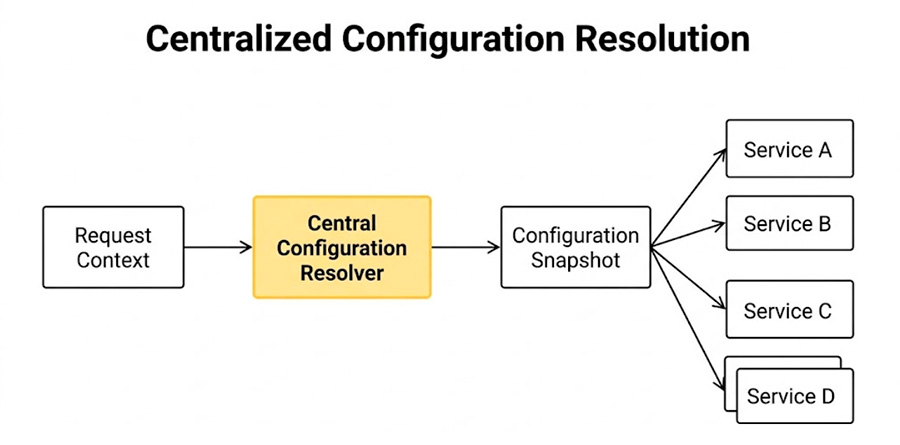
The resolver collects configuration from different layers by applying explicit precedence rules:
Global Defaults → Environment Overrides → Plan Configuration → Tenant Overrides
Making this hierarchy explicit ensures configuration resolution is deterministic and consistent, and works the same across different environments.
Schema-First Configuration
Configuration must be defined through strongly typed schemas and not through loosely structured data. Technologies such as JSON Schema or Protocol Buffers allow the system to do structural validation and type safety enforcement even before the configuration is deployed.
Schema-driven configuration facilitates a few vital features such as:
Under this scheme, configuration is a typed system agreement rather than a casual set of parameters. Therefore, all types of runtime failures caused by improperly formatted configuration can be avoided before deployment.
Configuration as Code
Tenant configuration should be treated as version-controlled artifacts rather than mutable runtime state. Keeping configuration in a special repository not only makes it possible to manage changes in a structured way but also leads to operational traceability.
In this model:
At runtime, configuration is delivered to application services through a dependable delivery mechanism, such as a distributed key-value store or a managed data store. Application services get hold of resolved configuration snapshots rather than reading directly from configuration sources, which means that the behavior remains consistent during the processing of a request.
Capability-Oriented Execution
Once the configuration is transformed into a typed capability model, application logic must operate on capabilities rather than tenant identifiers, inverting the decision boundary from identity-driven to model-driven execution. Instead of tenant checking by inserting:
the system finds the right capability implementation:
Through this setup, application code outlines the behavior of capabilities, whereas configuration identifies the capabilities available for a tenant in a given context. The platform can continue to change and introduce new capabilities without the need to add more complex conditional logic tied to each tenant separately.
Operational and Architectural Effects
Introducing a formal configuration architecture produces several systemic improvements.
Decoupled Release Cycles
Product teams can modify tenant capabilities and behavior through configuration updates alone, which means no app deployments are needed. This way, product lifecycle decisions can be separated from engineering release schedules.
Reduced Cognitive Complexity
Developers reason about platform capabilities instead of tenant-specific exceptions. The codebase specifies the system architecture, whereas the configuration defines how those capabilities are applied to tenants.
Operational Observability
Since configuration is versioned and the resolution is deterministic, the actual behavior of each tenant can be deduced from the configuration snapshot. This significantly improves debugging and incident analysis.
Governance and Compliance
A centralized capability model defines which tenants are allowed to use specific platform capabilities. This helps in making the system more auditable when it comes to compliance-sensitive features like data processing workflows.
Separating Capabilities, Entitlements, and Behavior
Pushing tenant-level customization to the limits wants multi-tenant SaaS vendors to change the way systems depict variability in their architecture, not just add more application logic.
If separate tenant behavior is hard-coded, the platform turns into a patchwork of conditional statements that not only reflect the changing needs of clients over time but also hinder the development of new platform features.
Besides, as more and more tenant-specific requirements creep in, the core of the application becomes heavily linked to the tenant identity, and that, in turn, contributes to the platform becoming difficult to change.
Elevating config to the top architectural concern leads to a totally different paradigm. By defining platform behavior through a schema-governed configuration system with explicit resolution rules, it becomes possible to deterministically separate three issues that are very often mixed up in traditional implementations:
• Capabilities → what the platform can do
• Entitlements → which tenants may use those capabilities
• Configuration → how those capabilities behave through constrained parameters and policies
This division makes it possible for application code to primarily concentrate on uncovering the capabilities of a platform, whereas configuration decides or determines the manner in which those capabilities are executed or transformed into functionalities, especially when handling multiple tenants.
Typically, adding new client requirements in such designs rarely leads to changes in application code. Often, the platform gets extended by developing the capability model further or by tweaking the validated configuration definitions. The codebase defines the system’s structural capabilities, while configuration represents a controlled and auditable model of tenant variability.
When dealing with multi-tenant platforms, especially those running at scale, this separation becomes critical. Introduction of new capabilities or behavioral changes can be performed without extensively modifying existing code by ensuring that customization is done through architectural configuration models and not through accumulated conditional logic or spaghetti code. It is very important that the tenant identity gives the lead in specifying entitlements, not the domain behavior.

