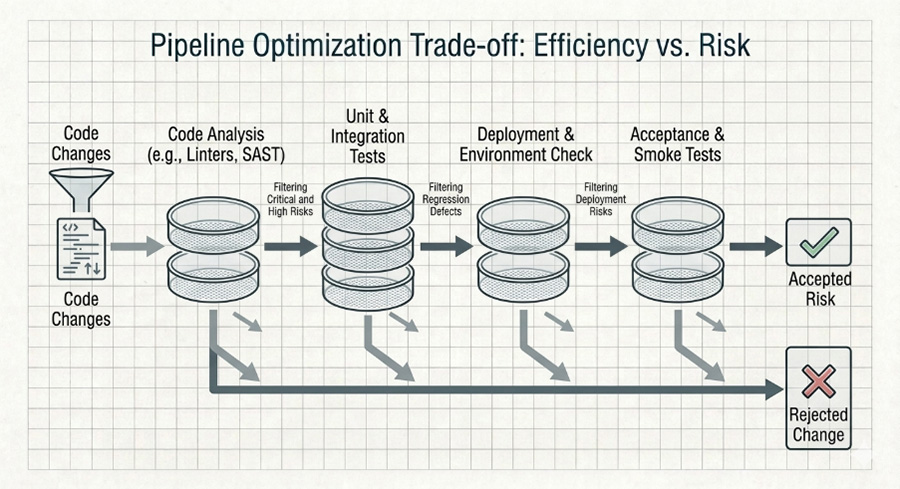
CI/CD pipelines can report successful runs time after time while underlying systemic risks remain undetected. This false sense of security is particularly harmful, as it delays corrective action and allows latent failures to propagate unnoticed.
This article examines recurrent mechanisms by which pipelines provide misleading indicators of system health, including flaky tests, environment drift, shallow validation strategies, excessive reliance on mocks, and non-reproducible builds.
By analyzing how these shortcomings distort feedback loops and undermine engineering confidence in delivery signals, this article proposes concrete design criteria for pipelines that evaluate reliability at the system level rather than mere procedural completion.
In today's DevOps, starting a CI/CD pipeline and making it work is commonly treated as a proxy for system correctness. If the pipeline passes, the change is typically considered safe to release. Release, deploy and rollback decisions are actually done around this one binary signal: green to go and red to stop.
In large-scale microservice systems, however, this assumption increasingly fails in practice. First of all, the pipelines typically orchestrate previously defined tests rather than validate overall system behavior. Also, the production system can fail by exhibiting degraded or incorrect behavior while the pipeline says everything is ok. This mismatch, referred to here as Green/Red Dissonance, describes the gap between the delivery signals that the pipeline produces and the actual running system.
Pipelines that only verify step completion can mislead decision-making. Decisions are made by relying on signals that have lost their connection to production reality. As a result, failures are not only overlooked; they are so hidden in a systematic way that only when they show up as user-facing incidents do they get noticed despite all the delivery indicators still showing success.
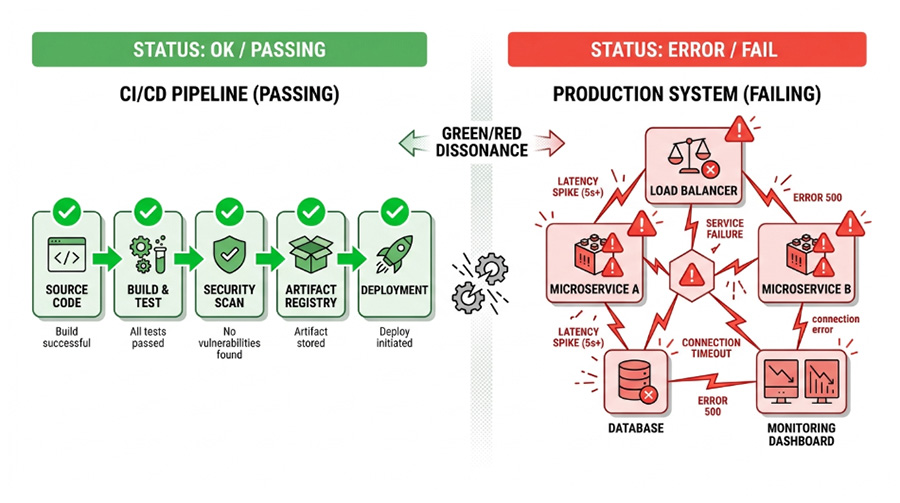
The main problem is not that we cannot observe well enough, but that the issue lies in flawed signal design within the delivery process. Modern CI/CD pipelines provide clear and repeatable signals, however these signals increasingly fail to show the real operational risk of a change.
The pipeline validates assumptions rather than system behavior. It verifies that the code compiles, isolated pieces of logic operate as expected, and that standard routines perform without errors. What it doesn't check is whether these assumptions still hold after the change is exposed to production configuration, real dependencies, and real concurrency. Over time, pipelines become optimized for passing tests rather than detecting risk. This is a deep-rooted aspect rather than an accidental change in culture.
Pipelines that are deterministic, quick, and reproducible favor signals that are consistent and disfavor those that reveal probabilistic or environment-dependent failures. Hence, signals that are most aligned with real incidents are invariably left out of the delivery gate.
The symptoms of this design failure are:
The above are all examples of the same problem. The delivery signals upon which we rely are optimized for procedural success, not for informing us when a change has increased the risk at the system level in a meaningful way.
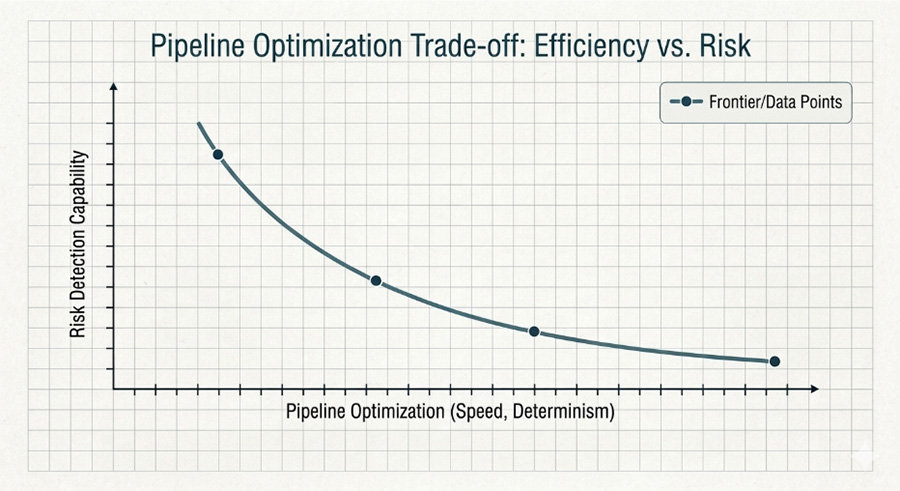
CI/CD pipelines lose the ability to diagnose what went wrong, not because they are badly done, but because they are set up for the wrong goal. In fact, pipelines mainly focus on repeatability, speed, and determinism.
These features are great for automation, but they directly contradict the requirement to reveal the probabilistic, environment-dependent failures that largely explain real-world incidents. Thus, we get a delivery system that reduces variance rather than exposing risk. The following mechanisms describe how this trade-off gradually destroys the diagnostic capabilities.
Pipelines are executed within managed, short-lived environments where the inputs, timing, and resource availability are mainly fixed. However, distributed systems fail in a piecemeal and surprising manner: issues such as partial failures, latency amplification, race conditions, backpressure, and degradation of dependencies rather than total outages. Isolated execution of a pipeline can verify code correctness at a local level, but it cannot identify concurrency, ordering, or failure propagation issues.
The fact that these situations did not occur during testing does not imply safety; it simply means that the system was not tested under scenarios that lead to its failure.
Mocks, though indispensable for unit-level validation, are inherently ill-suited for testing system behavior. Once dependencies are mocked, the test does not examine the external system anymore; it tests a static model of past assumptions about that system.
As genuine dependencies undergo version changes, configuration updates, or behavioral changes, mocks still deliver compliant responses. The test suite is stable because it is shielded from reality. Gradually, the pipeline develops trust in assumptions which might at some point be untrue.
Writing Infrastructure as Code reduces configuration variance, however it does not completely eliminate drift. Frequently, differences between pipeline and production environments are revealed in the layers that are not explicitly modeled: base images, cryptographic libraries, kernel networking behavior, identity and access policies, or resource constraints.
Since such differences infrequently lead to immediate and deterministic failures, they are not surfaced during pipeline execution. While the tests are running properly, the system becomes increasingly sensitive to conditions that exist only in production. Although the pipeline remains reproducible, it no longer represents reality.
Together, these factors and forces explain why pipelines that seem reliable are gradually losing their capability to identify genuine system-level risk. Execution stability is a result, but it is achieved at a loss of production behavior relevance.
Many organizations react to the diagnostic erosion of their pipelines by implementing mechanisms that stabilize delivery signals; however these mechanisms are not aimed at making the signals more accurate.
These mechanisms mostly end up removing the pain points momentarily while they actually decrease the usefulness of the pipeline to identify risks.
Auto-Retries: Converting Probability into Silence
Modern CI systems are often equipped with an automatic retry option that is meant to filter the noise resulting from sporadic failures. On the operational side, this enhances the perceived steadiness and reduces the time for getting feedback.
Nevertheless, auto-retries do not get rid of probabilistic failure; they only conceal it. If there is a test that fails sometimes, this failure corresponds to a distribution of outcomes under specific conditions. Repeatedly running the test until it passes automatically turns that range into a simple "pass" and the information about the instability is lost.
In the long run, the pipeline ends up aligned with the eventual success instead of the consistent correctness. What happens is that the reliability is not improved but the visibility of timing sensitivity, environmental coupling, and hidden concurrency problems is diminished.
Shallow Health Checks: Availability Mistaken for Correctness
Deployment gates often depend on extremely basic health probes, namely the receipt of HTTP 200 responses from liveness or readiness endpoints. These types of checks are great at simply detecting whether the process has crashed or failed during startup. However, they rarely validate functional correctness from a user perspective. For example, a service may keep reporting that it is healthy even though it has stopped writing data to the database completely, or it might have started to do the wrong kind of work internally while also getting slower due to external dependencies. In such scenarios, the availability measures would still be showing green but the correctness and quality of the service will be going down. Health endpoints are good at verifying that a process is up and running. But they can never tell that the system is really doing what is intended.
Stability Over Representativeness
A wider industry trend puts the emphasis on fast and reliable pipelines at the expense of representative ones. Stages that are the main reason for variability (e.g., integration tests against real dependencies, load-sensitive scenarios, or cross-service validation areas) are typically decreased or even confined to non-blocking jobs to maintain the speed.
Actually, this optimization makes a lot of sense. Quick feedback is the key to fast iteration. However, by leaving out systematically those scenarios which are the main cause of production failures, pipelines tend to develop towards procedural efficiency rather than risk detection. The overall impact of these policies is initially unnoticeable but very strong: the delivery systems become so good at verifying that the steps have been done correctly, that they gradually forget to be alert when a change significantly increases the systemic risk.
In order to regain the confidence in delivery indicators, simply increasing the number of tests is not enough. It is necessary to change the purpose of the pipeline. Rather than focusing on finishing the procedures as optimally as possible, the pipeline has to be built in a way that it detects faulty assumptions before changes are exposed to irreversible environments. The aim is not to verify the accuracy, but to constantly lower the level of unassessed risk.
Contract Testing as Assumption Control
Testing with mocked dependencies at the unit test level is still a necessity for quick validation on a local machine. That said, mocks lock the assumptions about external systems as they were at a particular point of time. To keep the services' interfaces in sync, each pipeline should run consumer-driven contract testing (CDCT).
Contract testing is aimed at making sure the shape and architectural expectations between connected services don't fall out of alignment. Last, they lessen the number of integration errors due to API changes over time. Unfortunately, they do not reliably validate latency, authorization behavior, or performance characteristics. Contracts manage the interface expectations but not the runtime behavior. When implemented properly, contract testing eliminates one kind of systemic risk: undetected interface divergence.
Ephemeral Environments as Failure Simulators
Pipelines ought to incorporate environments that mimic the kinds of limitations found in production rather than just cloning the configuration. The point isn't a perfect reflection, it's rather opening up the developer to realistic failure scenarios: unavailability of dependencies, resource contention, network variability, and configuration limits.
Performing integration or smoke tests on the containerized versions of the actual dependencies exposes the coupling assumptions that mocking alone cannot reveal. This kind of environment does not have to be a permanent one, but it should be sufficiently characteristic in order to be able to question the architectural assumptions. Being deterministic leads to doing the work faster. Being representative leads to being safer. Most advanced pipelines manage to find a balance between the two.
Flakiness as a Leading Indicator
Flaky tests signal unstable assumptions and may originate from application defects, infrastructure instability, or test design issues. There are many causes of flaky tests. Failures must be classified as associated with infrastructure instability, test isolation failure, timing sensitivity or true concurrency issues.
Effective response includes:
Once engineers lose faith in pipeline signals due to a small amount of tolerated instability, the delivery gate loses its function as a control mechanism.
Synthetic Transactions and Progressive Exposure
Post-deployment validation needs to be much more than checking the process health. Synthetic transactions simulate real user journeys and thus, help in checking the functionality against live dependencies and real configuration. Still, merely synthetics succeeding is not enough. They have to be accompanied by controlled traffic exposure like canary releases or progressive rollouts.
The pipeline should gradually move from a simple approval to the risk being exposed in stages, so that production behavior can be a part of the validation surface. Within this framework, production is not just a deployment target. Rather, it is a component of the risk assessment process.
Adding risk-oriented validation to your CI/CD pipelines won't just put extra layers of safety into your deliveries; it will also redistribute costs throughout the whole delivery lifecycle. These changes can be quantified by looking at the delivery throughput, the burden of coordination, and the motivating factors within the organization.
Slower Feedback, Lower Incident Amplitude
Services such as representative environments, contract verification and runtime validation add to the pipeline execution time. Pull requests are left open for longer periods. Developers find themselves waiting more often. The visible pace of delivery may drop. But this expense is made upfront. It turns the occurrence of unforeseen, large-scale production failures into the occurrence of controlled, smaller-scale pre-release interruptions.
The decision is not speed against quality; it is time and place of payment for instability. Teams concentrating only on the pipeline speed often shift the cost of failure to operations and end users.
Increased Coordination and Explicit Ownership
Contract testing and cross-service validation cause teams to get together more often. Interfaces must be versioned carefully. Breaking changes need to be negotiated instead of being deployed silently. In fact, this tension is inherent in the structure, not a matter of chance. This is what makes assumptions explicit and integration boundaries owned.
Otherwise, the informal coordination would be expensive when it happens during incident response under time pressure. Well-developed delivery systems trade development-phase friction for less production-phase chaos.
Metric Realignment and Incentive Shift
Pipeline quality controls are tightening. Consequently, green builds are fewer and more significant. Organizations that only rely on build success rate as a measure of productivity may first see this change as a drop in performance.
When teams are forced to reach certain pass rates, they usually react by cutting down on tests that may fail, skipping testing stages that take time, or even accepting the existence of flaky tests. To keep diagnostics trustworthy, the focus of incentives needs to shift from maintaining green to minimizing unrecognized risks.
Detecting a difference in configuration or instability in integration through a red build is not a failure of delivery but an accomplished detection. Even pipelines with the best design will, without a realignment of metrics, slowly deteriorate, prioritizing the optimization of procedures over everything else.
A CI/CD pipeline is more than an automation tool - it is a decision-making framework that permits changes even though the outcomes are uncertain. It is fundamentally a risk-filtering system, not a validation checklist. The real measure of its worth is not how frequently it succeeds, but how consistently its outputs reflect the actual behavior of the system. When pipelines are set up only for fast execution, predictability, and completion of steps, they slowly become unable to spot significant risks.
Continuous stable execution replaces being relevant to the real production. The change is not a sudden failure but a gradual loss of the trust in diagnostics. To regain that faith in the process, one needs to change the definition of delivery. The pipelines should be able to invalidate incorrect assumptions, reveal probabilistic instability, and check system behavior in representative scenarios. These changes bring in friction, the need for coordination, and longer feedback times.
On the other hand, they also help diminish and control the scale of and the surprise element in production problems. It is a good indicator of a properly working control system if a red build reveals an unseen instability. A pipeline that is always green but does not pick up on the systemic risk is not efficient; it is just out of tune. Ultimately, the long-term health of complex systems will be less about the speed at which changes are made and more about the effectiveness with which uncertainty is revealed before the changes are irreversible.